Professor Tiantian Chen Leads Two International Mobility Projects on Automated Driving and Remote Operation
페이지 정보

작성자 최고관리자
작성일 2026-10-05 14:53 댓글 0 조회 186
본문

Tiantian Chen Leads KAIST Research in KRW 10 Billion Korea–U.S. and KRW 11 Billion Korea–Czech Mobility Projects
Human-centered AI for automated driving with Purdue University and multi-vehicle remote operation with Czech partners; KAIST's share totals KRW 1.7 billion
Dr. Tiantian (Nicole) Chen, Associate Professor in the Cho Chun Shik Graduate School of Mobility at KAIST and head of the Human-FACTS Lab, is leading KAIST's participation in two new international joint research projects. One is a Korea–U.S. project with Purdue University on human-centered AI for automated driving, backed by KRW 10 billion in Korean government funding. The other is a Korea–Czech project on the remote operation of multiple vehicles, with a total budget of KRW 10.97 billion. KAIST's share of the two projects totals KRW 1.7 billion.
The five-year Korea–U.S. project, "Modular Chiplet Structure-Based Human-Centered AI Foundation Models for Robust, Scalable Automated Driving" runs from August 2026 through July 2031 and is led by BOS Semiconductors (https://www.bos-semi.com/). It is funded under the Global Industrial Technology Cooperation Center (GITCC) Program, a program of Korea's Ministry of Trade, Industry and Resources (MOTIR) administered by the Korea Institute for Advancement of Technology (KIAT). The consortium is to receive KRW 10 billion in Korean government funding over the five years (approximately US$7.3 million). Of this, KRW 1 billion is allocated to KAIST.
The Korea–Czech project, "Development of a Detachable On-Board Device for Multi-Vehicle Remote Operation and Safety Enhancement Technologies (DOVE)" runs from July 2026 through December 2029 and is led by BYDA (https://www.bydasensor.com/). It is an international joint R&D project in which Czech institutions participate. It is funded under the Smart Car sub-program of MOTIR's Automotive Industry Technology Development Program and administered by the Korea Planning & Evaluation Institute of Industrial Technology (KEIT). The project's total budget is KRW 10.97 billion; KRW 700 million is allocated to KAIST.
"Whether a vehicle drives itself or is operated remotely, there is still a person involved: the driver in the seat, or the operator overseeing several vehicles at once," Chen said. "Together with Korean companies and research institutes, Purdue University and our Czech partners, our lab wants to make these technologies work safely with that person."
The KAIST and Purdue technologies will be co-designed to run inside the vehicle on the modular, chiplet-structured AI accelerator of lead institution BOS Semiconductors rather than on data-center GPUs. Chiplets are small chip modules that are combined into one processor. Validation in real vehicles is planned in Korea and the United States.
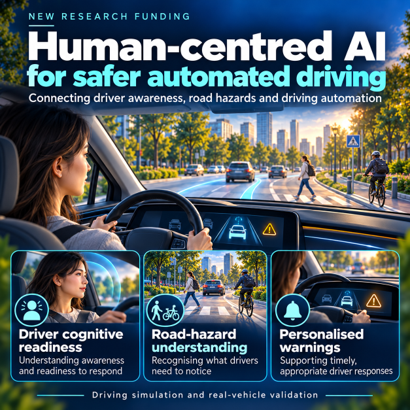
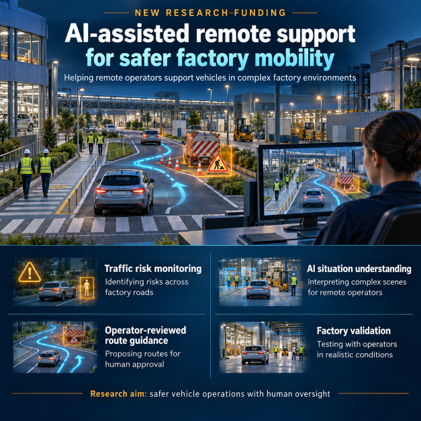
The Korea–Czech project, DOVE, will develop a detachable on-board device that allows ordinary production vehicles to be operated and supervised remotely without being modified. One remote operator will be able to oversee several vehicles. To reinforce safety, the project will also develop risk prediction, communication-quality management and AI-based perception that works in cooperation with infrastructure.
Besides BOS Semiconductors, KAIST and Purdue University, the Korea–U.S. consortium includes Deep-Insight and the Korea Automotive Technology Institute (KATECH). In DOVE, BYDA and KAIST work with DH Autoware, Renault Korea, SAESOL Tech, LG Electronics, AUTOBIZ SYSTEMS, and KATECH, and on the Czech side with VSB – Technical University of Ostrava, INTENS Corporation, and O2, with Škoda Auto as an associated partner.